Dwarf Japanese Cedar vs Boxwood: Size and Maintenance
Beside the step of an old farmhouse we remember a boxwood hedge that had been clipped every June for longer than anyone could say, and we remember the spring the leafminers came. The new leaves went blotchy and yellow, then began to drop, and by midsummer the hedge looked tired in a way no watering could cure.
Since then we have watched customers ask for something with that same tidy, rounded presence that asks less of them. Dwarf Japanese cedar 'Globosa Nana' is the plant we point them toward, with one catch: it grows differently from boxwood, and it takes more room than most people expect.
We'll walk you through the look you want, the pests you would rather avoid, the space you really have and the shearing you will really do, then where the cedar belongs in a foundation bed and which plant we would choose for you.
Do You Want Boxwood's Look at All?
Start here, because every other question is moot if the look is wrong. Boxwood has small, closely set leaves that take a clipped edge better than almost anything, which is why it turns up in formal beds, entry walks and low hedges. A boxwood hedge reads as a line, a wall of green with a ruler laid along its top.
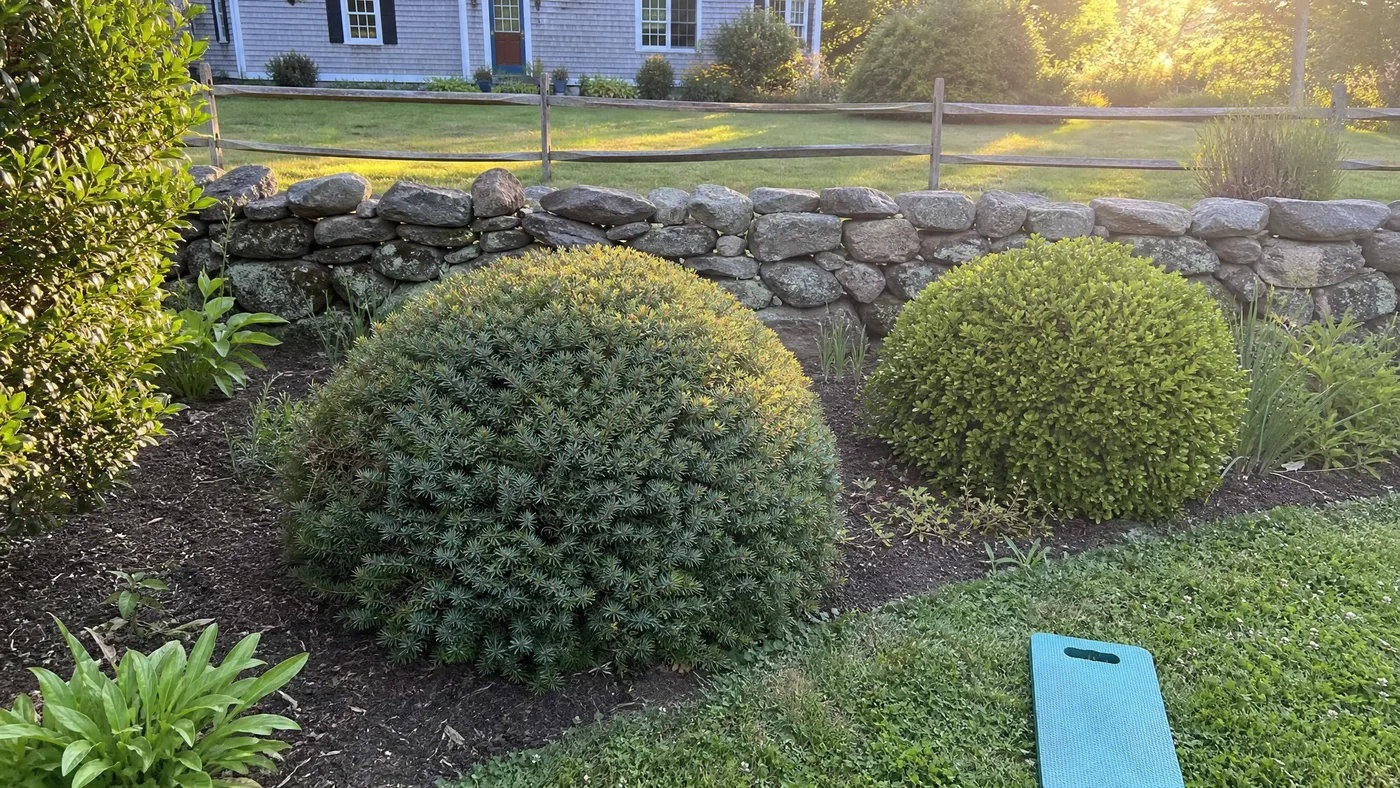
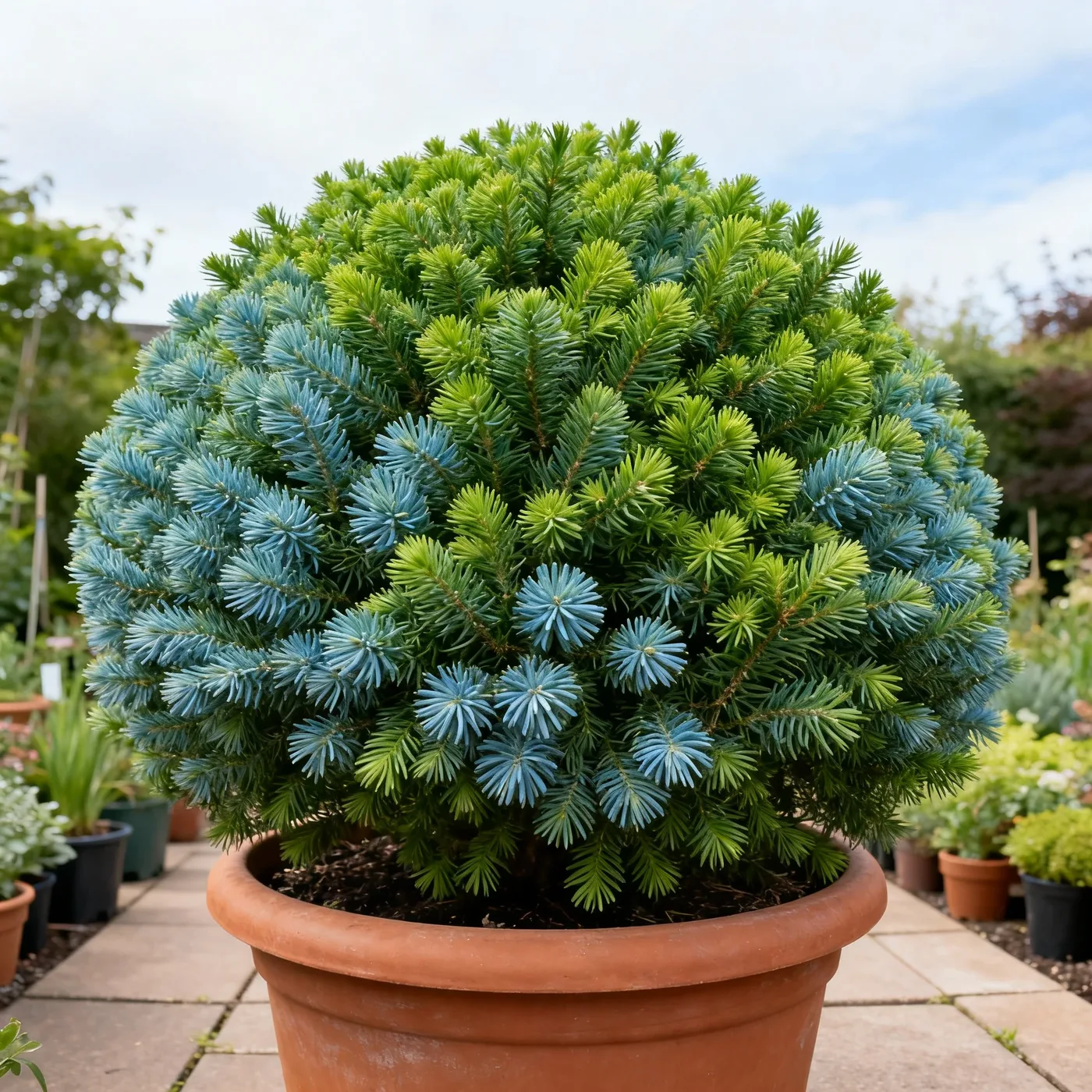
Dwarf Japanese cedar reads as a dome. The needles are bluish-green and awl-shaped, softer and more bristly than glossy, and they become rusty-red during the winter months, so the bed is a different color in January than it was in July. The habit is naturally rounded, and the plant is grown for its foliage rather than any flower.
Customers usually ask us whether a cedar can be clipped into a crisp square to stand in for boxwood. We would not buy it for that job. A cedar wants to be a soft mound, and if you fight that you lose the very thing it does best, which is looking settled without anyone's help.
So the first decision is a simple one. If your design depends on clean geometry, such as a knot, a parterre or a flat-topped low hedge, boxwood is still the right tool and the rest of this guide is about protecting it. If you want rounded shapes, a bristly texture and some winter color, keep reading, because that is where the cedar earns its place.
Weighing Blight and Leafminer Risk in Boxwood
This is the decision that pushes most people toward a substitute. Boxwood is susceptible to boxwood blight and leaf spot diseases, with leafminer, boxwood mite and boxwood psyllid as its insect pests. On top of that, there are no known resistant boxwoods, so you cannot shop your way around the problem by picking a different one.
How Leafminer Shows Up
Boxwood leafminer is the most serious insect pest of boxwood, and the larvae feed inside the leaf, creating a mine. Leaves yellow, shrink and drop, which is the look of a hedge in a bad year. American boxwood is the preferred host, but English and Japanese boxwoods are also susceptible, so the name on the tag gives you little shelter.
What the Cedar Can Still Get
Leafminer and boxwood blight are boxwood problems, and a cedar, which belongs to the cypress family, is not on their menu. That does not make it bulletproof. Cryptomerias are typically insect-free but may have leaf blights or fungal diseases, and our rundown of common dwarf Japanese cedar problems covers what to watch for.
Our choice: plant the cedar in any bed where you have lost boxwood before, or where a neighbor has. If your boxwood is healthy and nobody nearby has had trouble, pests alone are not a reason to switch, though they are a fair reason to stop planting new boxwood into a spot that has already failed once.
Checking Your Wall Against a Mature Dwarf Japanese Cedar
This is where the swap most often goes wrong. 'Globosa Nana' matures at 2 to 4 feet tall and 3 to 4 feet wide, and it keeps growing larger with age. It is wider than it is tall, and because it is slow-growing, the first few years flatter it.
A dwarf boxwood is usually held where you want it by regular clipping. Left alone, common boxwood can grow slowly up to 15 to 20 feet tall at maturity, and it can be kept much shorter only through pruning. The cedar has no clipping holding it back, so what you plant is the size you will eventually have.
Reading the Tag Before You Buy
Dwarf globe forms are sometimes sold under this cultivar's name without being it, so confirm the tag says 'Globosa Nana' and ask the grower what size to expect. Many people hear "dwarf" and picture a plant that stays the size of its pot. That is not how dwarf conifers behave. Dwarf means slow, not still.
Measuring Your Bed
Measure from the wall to the edge of the bed and plan on a mature width of 3 to 4 feet. Set the center of each plant at least half that width from the wall, and farther if you want air around the siding and room to walk past. Our guide to how big dwarf Japanese cedar gets and how fast helps you picture year five.
Our choice: a bed too shallow to hold a 3 to 4 foot width, or a spot under a low window where even 4 feet would block the glass, is boxwood territory. Anywhere deeper than that can hold a cedar comfortably.
How Much Shearing Will You Actually Do?
Boxwood stays a hedge because someone keeps cutting it. It can be kept much shorter than its mature height through pruning, and that is how every clipped boxwood bed works: size is a chore you repeat. No single session is heavy, but the chore comes back every year, and a skipped year shows in the ragged top line.
The cedar does not ask for that. Its naturally rounded habit needs no maintenance to keep its attractive form, and slow growth means very little drifts out of line from one season to the next. Over the years, the boxwood's clipping adds up to a lot of afternoons, and the cedar's adds up to a handful of snips.
When a Cedar Still Gets Pruned
None of this means the cedar is never touched. You may want to remove a stray or damaged tip, and the timing and cuts are in our guide on how and when to prune dwarf Japanese cedar. That is an occasional snip with hand pruners, not a seasonal job with hedge shears.
Our choice: if you enjoy clipping, or already pay someone to do it, boxwood is a fine partner and gives you the crisp result you are paying for. If you know you would forget by the second June, plant the cedar and let the shape take care of itself.
Choosing Dwarf Japanese Cedar for Foundation Corners
Corners are where the cedar earns its keep. A house corner is a hard right angle, and a dome 3 to 4 feet wide softens it without any shaping. Put one at an outside corner, let the bed curve away from it, and the wall looks planted rather than fenced.
Corners and Door Sides
A matched pair flanking a door also works, because slow growth keeps two plants close in size for years. The rusty-red winter cast stands out against siding in a way a steady green does not. For ideas on what to plant between and beside them, see our landscape uses and companion plants.
Light, Water and Soil at the Wall
The cultivar performs best in full sun to partial shade, in moist, well-drained soil of any texture and pH, so most house beds suit it. It also resists deer, and the species resists rabbits too, which helps in beds that border woods or open lawn.
Watch the water. NC State calls the cultivar drought resistant, while Clemson says cryptomerias need irrigation during drought, and we side with the latter for a bed against a wall. Soil under wide eaves can stay dry while the rest of the yard is wet, so water new plants well and check those spots in dry spells.
Our choice: cedar at the outside corners and beside the door, boxwood only where you truly need a clipped edge.
Settling on Dwarf Japanese Cedar or Boxwood
Here is how the earlier choices stack up side by side. Read down your own column and note where the answers split, because the plant that wins most rows usually wins the bed.
| Decision | Boxwood | Dwarf Japanese Cedar |
|---|---|---|
| Look | Crisp, clipped lines | Soft dome with rusty-red winter color |
| Blight and leafminer | Susceptible, with no known resistant boxwoods | Not a host, though leaf blights or fungal diseases are possible |
| Mature size | Held down by regular clipping | 2 to 4 feet tall, 3 to 4 feet wide, larger with age |
| Shaping | Shearing every year | Naturally rounded, no maintenance for form |
| Best spot | Formal edges and low hedges | Corners, door sides and soft mounds |
We would choose the cedar for most foundation beds, as long as the bed is deep enough for a 3 to 4 foot dome. This cultivar grows in zones 6a through 9b, with 8b missing from that range, so confirm with your local extension service if you garden in 8b or in zone 5. Our guide to which zones dwarf Japanese cedar grows in goes further.
Pick boxwood when you want clipped geometry, your bed is shallow, and you are happy to shear it and watch for blight. Pick the cedar when you want a soft mound that holds its own shape and stays out of the way of the pests that trouble boxwood.
Dwarf Japanese Cedar Years Later, Without the Shears
Check the room first, then the pests, then your own appetite for shearing, and the choice usually makes itself. The cedar gives up crisp edges and asks for a deeper bed, and in return it gives you a plant that holds its dome, keeps clear of boxwood blight and leafminer and shows rusty-red in winter.
Dwarf Japanese Cedar
Nursery-grown Dwarf Japanese Cedar in sizes from 1 Gallon, shipped to your door.
From $39.97
Shop Now →Our Dwarf Japanese Cedar is raised in our farm beds, where it gets bright sun or a touch of shade and soil that stays damp but drains well, and we have never once shaped it with shears. We ship only plants we would plant ourselves, so if the cedar's easy, self-keeping dome sounds better to you than boxwood upkeep, take a look at the Dwarf Japanese Cedars we have ready.