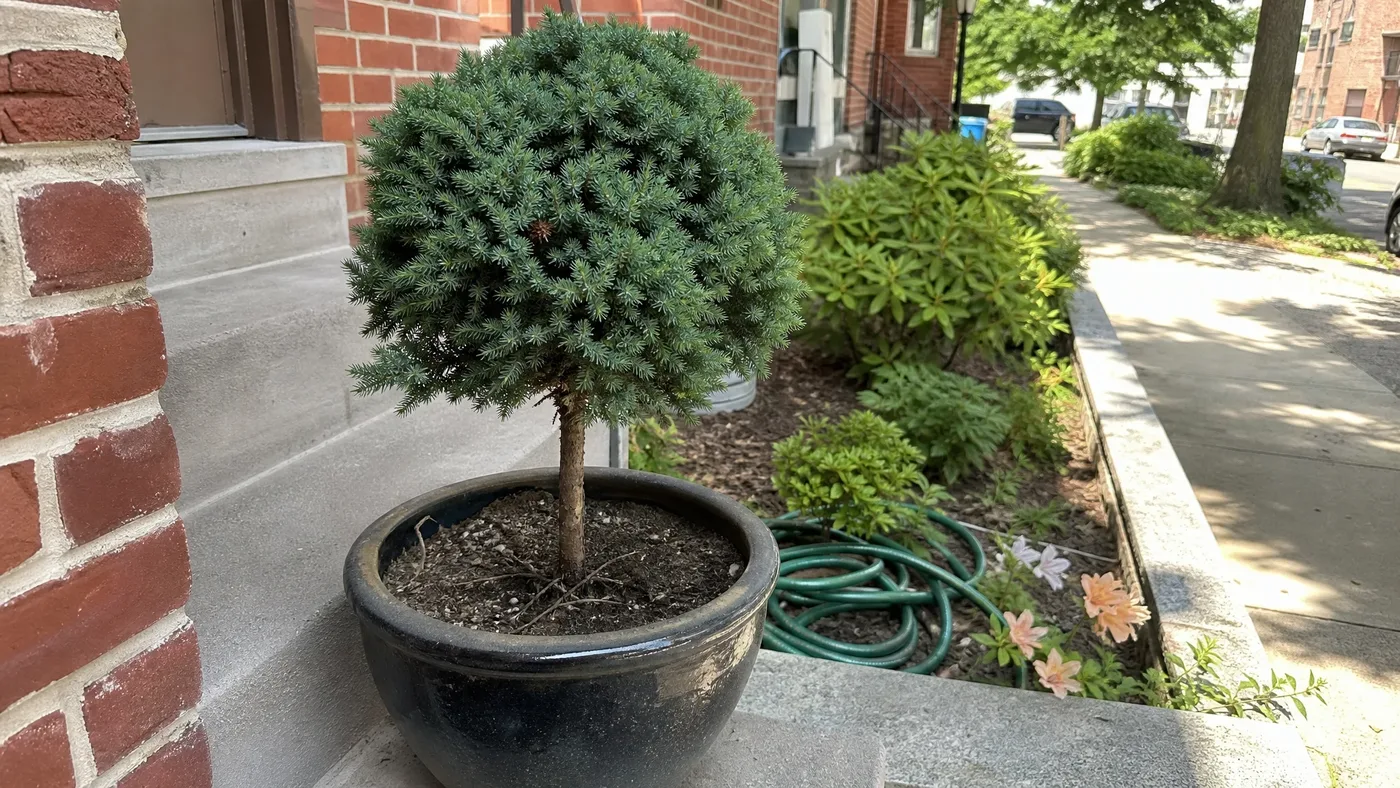
How to Grow a Dwarf Japanese Cedar Standard
The parcel is a tall, narrow box, and what is inside looks wrong at first: a bare stick with a green ball strapped to the top. Cut the straps, lift the plant out by the pot and stand it upright where wind cannot reach it. Then look closely at the stick, because it is not a Dwarf Japanese Cedar at all.
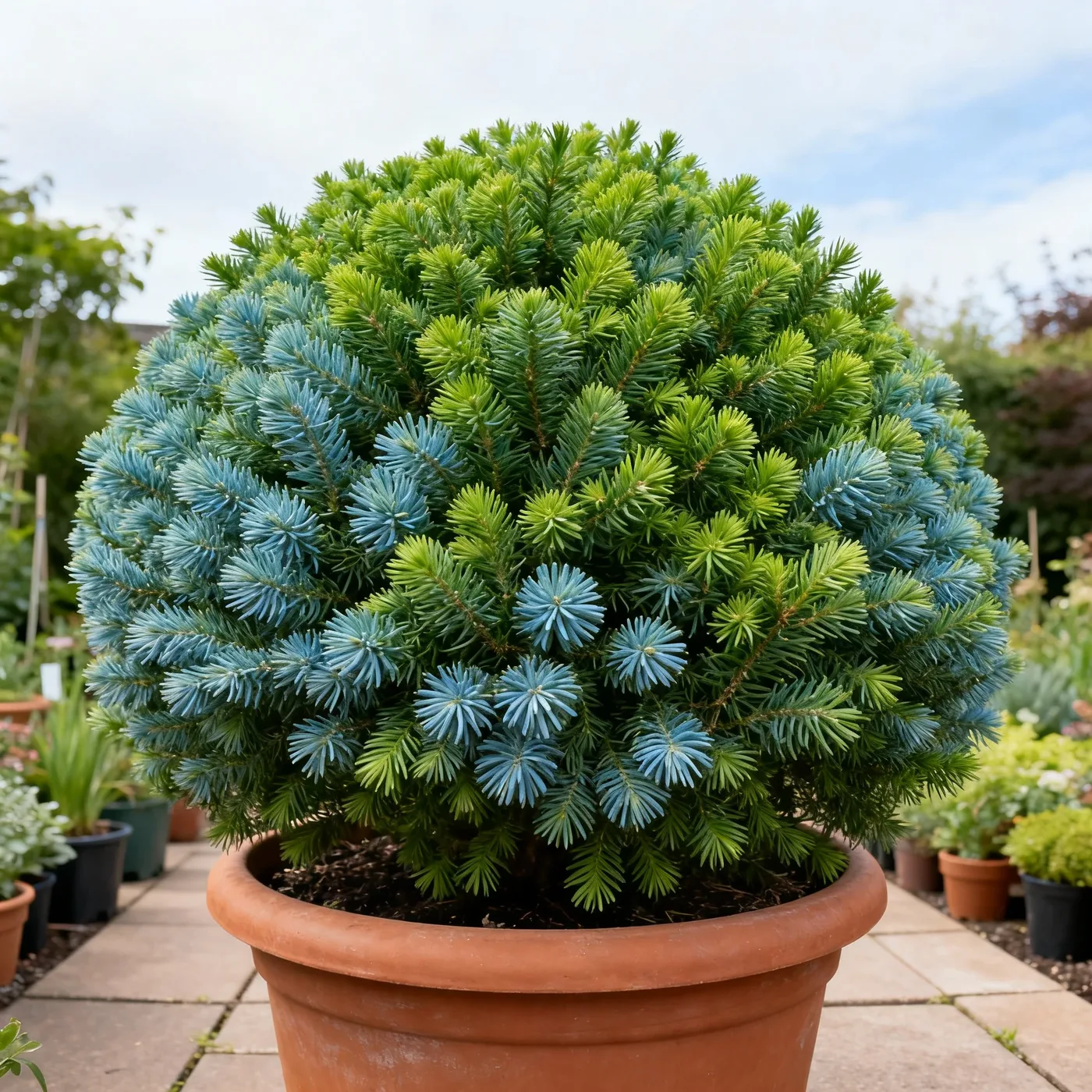
'Globosa Nana' is a naturally low mound with no trunk of its own, so every standard is two plants joined at a graft that stays for life. That is why its care differs from the bush form most of our guides cover, and why a missed sprout or a loose tie matters more here.
This article talks about how a Dwarf Japanese Cedar standard is built and answers the questions customers ask us most. Read on to learn how to read the graft, choose a stake and ties, pick a pot that will not tip, trim the ball and trunk sprouts, and get the plant through shipping and winter.
What a Dwarf Japanese Cedar Standard Really Is
Set a standard beside the bush form and the difference reads from across the yard. The bush hugs the ground as a mound. The standard lifts a mound of the same plant to eye level on a straight stem, so it looks like a lollipop. That makes it an accent plant, closer to a piece of garden furniture than to a ground-level shrub.
The bush form is modest. It reaches a mature height of 2 to 4 feet with a width of 3 to 4 feet. The species behind the trunk is a forest tree that grows 50 to 70 feet tall. A standard borrows from both: a slow globe riding on a stem from the upright side of the family.
Why Every Standard Is a Graft
Globosa Nana has no central leader. Left alone it spreads into a mound and never climbs, so you cannot train it up a cane the way growers train a rose or boxwood standard. The cultivar propagates by stem cutting, and a cutting only gives you another mound. A standard has to be built by grafting the globe onto an upright Cryptomeria rootstock.
That one fact separates its care from the bush form. You get a graft union to protect, a stake to maintain and rootstock sprouts to remove. A bush never asks any of that of you.
Where a Standard Earns Its Place
Standards suit four jobs: a matched pair flanking a door, a single accent at a formal entry, a pot on a patio and a quiet note in a Japanese-style bed. Each uses the same trick. The globe rides at eye level and holds its shape all year, with bluish-green needles that turn rusty-red in winter. Our guide to landscape uses and companion plants covers what to plant beneath one.
The Bare Trunk and Its Grafted Globe
Run your hand up the trunk of a new standard until the surface changes. That spot, usually a ring or a slight bulge, is the graft union. Below it is rootstock, the upright Cryptomeria stem and roots. Above it is 'Globosa Nana', the globe you paid for. Nearly everything in this section comes down to keeping those two plants in their own territory.
What the Union Needs
Keep the union clear of soil, mulch and wet leaves, and never bury the trunk deeper than it stood in the pot. Burying the union asks the globe to root, and it hides the one place you need to watch. Look at the union each season. A healthy one is closed and snug, with no gap and no cracks in the bark. A slight swelling at the join is common and is not a fault.
If the globe turns on the trunk or shifts when you nudge it, stop handling the plant by the head and ask the nursery you bought it from.
Why the Trunk Stays Bare
One of the most common questions we get is whether the lower trunk will fill in with needles. It will not, and you do not want it to. The trunk is rootstock, so any shoots on it belong to the rootstock and not to the globe.
The bare stem is the design. It holds the ball clear of the ground and lets you see the shape from the base up. The globe grows outward at the bush's slow pace and does not travel down the stem. Anything that does appear on the trunk is a sprout, and Section 6 covers how to remove it.
Choosing a Dwarf Japanese Cedar Standard to Buy
Hold the plant at arm's length and read it from the bottom up: pot, trunk, union, globe. A standard that fails does so at one of those four points, and each takes a minute to check at the counter or on your porch. Start with the label. The trade sometimes sells unnamed dwarf globe forms under the name 'Globosa Nana', so ask the seller to confirm the cultivar tag before you pay.
Use this checklist when you buy and again when the box opens:
- The tag reads Cryptomeria japonica 'Globosa Nana', and the seller can tell you the globe is grafted onto a Cryptomeria rootstock.
- The trunk is straight and firm, with no kinks, cracks or soft spots that flex when you press on them.
- The union is closed and smooth, and the head does not wobble when you hold the trunk below it and nudge the globe.
- The globe is evenly rounded with bluish-green needles. Rusty-red tones in winter are normal for this cultivar, but crisp brown patches are not.
- Any green shoots below the union are small and few. A trunk crowded with sprouts has been left unattended.
- The mix is moist, not soggy, and the pot stands upright without a lean.
Receiving the Delivery
Open the box the day it arrives, even if you plan to pot it later. Cut the straps that held the head, lift the plant out by the pot rather than the trunk and stand it upright out of the wind. Photograph any damage before you touch anything else, and report it to the seller right away.
If the mix is dry, water it. Our buying guide on container sizes will help you judge whether the pot that came with the plant suits where it will live.
Stakes, Ties and Wind Protection
A standard in a breeze behaves like a flag on a short pole. The globe is a dense mass of needles on a slim stem, so it catches wind like a sail while the trunk bends at the union, the weakest point. This cultivar requires a sheltered position, and the standard form makes that stricter. A stake and a sheltered spot work together.
Choosing the Stake
Use a stake that is rigid and long enough to reach just below the union. Hardwood, bamboo and metal all work. Avoid anything that reaches into the globe, because a stake rubbing the head wears the needles and the union. In the ground, drive it beside the root ball before you backfill. In a pot, set it at the edge of the mix so it does not spear the roots.
Treat the stake as permanent until the trunk holds the head still in a stiff breeze without it. Most standards never reach that point.
Using Ties
Wide, soft ties are the right material. Rubber tree ties and fabric straps spread the pressure, while wire, cord and thin plastic cut into bark as the trunk thickens. Make two ties, one just below the union and one lower. Cross each in a figure eight so the trunk never touches the stake, and leave a little give so the trunk can flex.
We often see ties left on for years until they bite into the trunk. Check them each spring and fall, and re-tie any that have gone tight.
Placing the Plant Out of the Wind
Stand the pot or dig the hole where a wall, fence or hedge breaks the wind. Avoid gaps between buildings, where wind speeds up. The cultivar takes full sun to partial shade, so you can choose between sites on that basis. Pick the calmest one. Our planting guide covers digging the hole.
Pots and Potting Mix for a Top-Heavy Plant
A standard in a light, narrow pot goes over at the first gust, and a fall can crack the trunk at the union. The globe sits high and carries all the weight, so the pot has to supply the counterweight. Our guide to growing Dwarf Japanese Cedar in pots covers the bush form. The standard needs a few extra rules.
Choosing the Pot
Pick a pot that is wider at the base than the globe is across, and heavy. Stone, concrete and thick ceramic keep the center of gravity low. A plastic pot works only if you ballast the bottom. Every pot needs drainage holes and feet that lift it off the ground.
Size up modestly. The plant is slow growing, and a large pot of mostly empty mix stays wet around the roots. This cultivar may be susceptible to Phytophthora root rot, and wet mix invites it.
Mixing the Soil
The cultivar does best in moist, well-drained soil of any texture and pH. The roots of a standard are not the cultivar's, though. They come from an upright Cryptomeria, and the species prefers rich, moist, well-drained, acidic soils. We lean toward the species. Use a quality potting mix opened up with coarse bark so water drains freely, and skip garden soil, which packs down in a pot.
Water deserves the same care. The cultivar resists drought, while Arkansas Extension says the species lacks drought tolerance and Clemson says that although cryptomerias are moderately adaptable to dry sites, they need irrigation during drought. A pot dries faster than ground, so do not test it. Water when the top of the mix feels dry.
Trimming the Dwarf Japanese Cedar Ball and Trunk Sprouts
Walk around a standard with a pair of pruners and you will usually find the same thing: a tuft of fresh, upright growth low on the trunk or at the base of the pot, looking different from the dense globe above. That is a rootstock sprout. It is the one thing on this plant that needs regular cutting, and the globe itself needs very little.
Tools
You need sharp bypass hand pruners and a rag with rubbing alcohol to wipe the blades. Soft new sprouts also pinch off with a thumbnail. Keep the pruners clean, because you are working close to the union.
Removing Trunk Sprouts
Cut each sprout flush with the trunk, leaving no stub. A stub keeps the bud alive and invites a second shoot. Do the same for shoots rising from the soil at the base. Check every time you water, and again after a wet spell, since a sprout left to grow takes energy that belongs to the globe. Take care not to nick the bark or the union as you cut.
Some advice says to leave a few lower shoots to thicken the trunk. We do not, on a finished standard. Those shoots are rootstock and want to become a tree.
Shaping the Ball
The cultivar's naturally rounded habit needs no maintenance to keep its form, so the globe should need only light attention. Snip a stray tip that breaks the outline and leave the rest. Cut into green, needled growth only. Conifers like this often do not sprout from bare wood, so a deep cut can leave a permanent hole in a ball that grows slowly. Our guide to pruning Dwarf Japanese Cedar covers the bush form in more depth.
Shipping and Winter Care for a Dwarf Japanese Cedar Standard
A standard travels best upright and snug, the way it arrives in our own boxes. Moving one across town and mailing one across the country follow the same order: prepare the plant, secure the head, protect it on the way, then unpack. We pack ours upright with the head secured and the trunk held still, which is the standard to ask for from any seller.
Preparing and Moving It
Water the plant the day before a move so the mix is moist but not dripping. Remove sprouts first, since they snag in packing. Pad the stake, then secure the head so it cannot swing against the trunk. Keep the plant upright in the vehicle, wedged so the pot cannot tip. Never carry it by the globe.
Unpacking
Follow the steps in Section 3: cut the straps, lift by the pot, check the union and trunk, and water if dry. Retie the trunk to its stake with soft ties before the plant goes outside, because wind strikes hardest on a freshly moved plant.
Protecting It in Winter
The cultivar grows in zones 6a through 9b. The rootstock's hardiness may differ, so ask your local extension service what applies in your area. A pot is colder than ground, because the roots lack the soil's insulation. Move it against a sheltered wall, group it with other pots and keep the mix from freezing solid.
Wind does more harm than cold to a head on a stick. Set up a burlap screen on the windward side, leaving the globe open to air. Rusty-red needles in winter are normal, so do not mistake them for damage. Our winter care guide covers the bush form in more depth.
Supplies to Have Ready Before the Next Delivery
A Dwarf Japanese Cedar standard is a graft on a stick, and most of its care is simple if you prepare in the right order. Check the union, hold the head still, give the roots a heavy pot with free drainage, cut sprouts flush and keep the wind off in winter. Gather these before the box arrives:
- A rigid stake long enough to reach just below the graft union.
- Wide, soft ties such as rubber tree ties or fabric straps.
- A heavy pot with drainage holes and feet, plus potting mix and coarse bark.
- Sharp bypass pruners and a rag with rubbing alcohol.
- A sheltered spot picked out, and burlap on hand for a winter wind screen.
- A phone to photograph the plant and any damage the day it arrives.
Dwarf Japanese Cedar
Nursery-grown Dwarf Japanese Cedar in sizes from 1 Gallon, shipped to your door.
From $39.97
Shop Now →Planting a standard in a pot works best when the tree on top began well, and ours begin in farm beds with bright sun or a little shade, where the soil stays moist and drains freely. Our own growers raise and pack every top-quality Dwarf Japanese Cedar, and we would gladly stake and shelter each one in our own gardens. When your stake, ties and pot are ready, pick out a plant to train into a standard for your own garden.