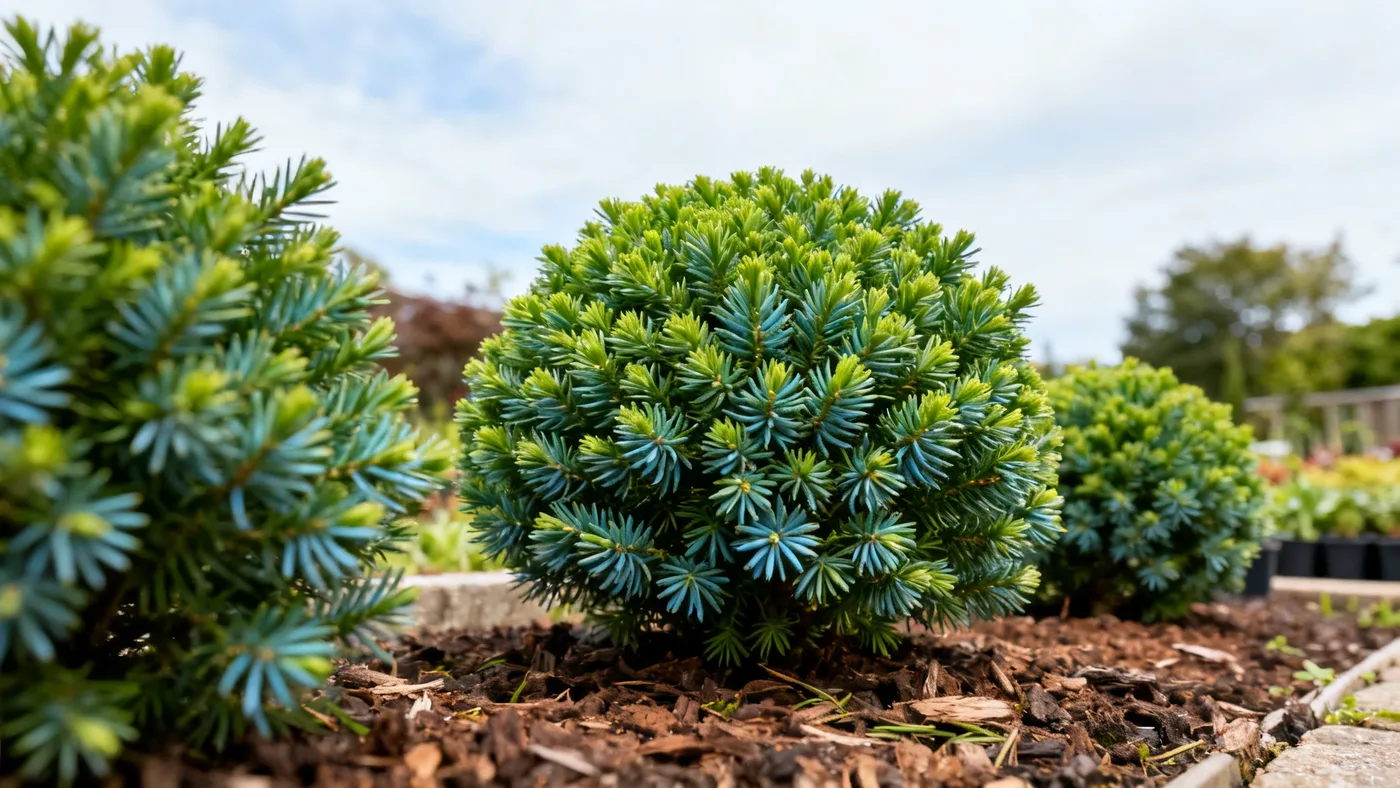
Dwarf Japanese Cedar Varieties and Cultivars Compared
The nursery trade sells dwarf Japanese cedar under many names. Walk into a garden center and you might see "Dwarf Japanese Cedar," "Cryptomeria japonica Globosa Nana," or a cultivar name like "Black Dragon." The plant you take home may be a documented named cultivar or an unnamed dwarf globe selection. This comparison helps you understand what types of dwarf Japanese cedar are available, what matters when choosing, and how to identify which one you are buying.
Dwarf Japanese cedar cultivars are not one plant. The species, Cryptomeria japonica, is native to Japan. Dwarf forms are nursery-selected cultivars developed over decades of breeding. The botanical name Cryptomeria japonica Globosa Nana has become a generic label for many dwarf globe types, even when the exact cultivar is undocumented. This matters because mature size, growth rate, cold hardiness, and foliage color shift between true cultivar clones and unnamed seedlings.
The Named Dwarf Japanese Cedar Cultivars
Specialty nurseries stock several documented cultivars of dwarf Japanese cedar varieties. Here is what you may find:
Cryptomeria japonica Globosa Nana
This is the reference dwarf form. Most nurseries use it as the standard dwarf Japanese cedar. Globosa Nana forms a dense, rounded mound. Mature height ranges from 3 to 6 feet (varies with age and site conditions). Mature width runs 4 to 6 feet. The foliage is blue-green with soft, awl-shaped needles. Growth rate is roughly 3 to 6 inches per year, making it slow and predictable. Hardiness spans USDA zones 5 to 9. Foliage often bronzes or purples in cold winters, a normal seasonal shift, not disease. Best for foundation plantings, rock gardens, and specimen accents where a consistent rounded form is valued.
Tansu
Tansu is a known cultivar selection that specialty nurseries stock. Like other dwarf Japanese cedar cultivars, it is a slow-growing conifer with a compact, mounded habit. It shares the same hardiness (zones 5 to 9) and general size range (3 to 6 feet tall, 4 to 6 feet wide at maturity). Foliage character may show subtly different needle texture or hue. The growth form remains dense and globe-like. Best for container planting, Asian-inspired gardens, and collectors who value a named cultivar's documented provenance.
Black Dragon
This cultivar is prized for dramatic foliage. The name hints at coloration darker than standard green forms. The growth form is dense and compact, following the dwarf Japanese cedar pattern. Foliage is notably darker, often bronze or very deep green, providing year-round visual punch. Size and hardiness match other dwarf forms: zones 5 to 9, 3 to 6 feet tall at maturity. Best for contrast in mixed plantings, year-round visual interest, and collectors seeking bold foliage.
Vilmoriniana
Vilmoriniana is another specialty cultivar available through mail-order and larger regional nurseries. The form is dwarf and globe to slightly columnar. Foliage is fine-textured with soft needles. Hardiness and general size match other dwarf forms: zones 5 to 9, 3 to 6 feet at maturity. This cultivar is particularly noted for sustained container suitability, making it a top choice for long-term container culture. Best for bonsai, small containers, and alpine troughs.
Little Diamond
Little Diamond is marketed as an especially compact, slow-growing form of dwarf Japanese cedar varieties. Mature size often stays smaller than Globosa Nana over 10 to 15 years. The foliage appears fine and feathery. This cultivar is ideal for rock gardens, tight spaces, and container displays where truly minimal growth is desired.
Elegans (Plume Cedar Form)
Elegans stands apart: it is a different growth type. Unlike the globe forms above, Elegans is a "plume cedar" with a more columnar or feathery habit. The form is upright, not mounded, with softer, more open branching. Foliage consists of longer, feathery needles that often color to red-bronze in winter, providing dramatic seasonal interest. This cultivar suits tall, narrow spaces where you want vertical interest instead of a geometric globular shape. It is best for transitional accents and distinct seasonal color.
Comparison Table: Dwarf Japanese Cedar Cultivars at a Glance
| Cultivar | Mature Height | Mature Width | Growth Form | Foliage Color | Winter Interest | Container Suitable |
|---|---|---|---|---|---|---|
| Globosa Nana | 3 to 6 ft | 4 to 6 ft | Rounded mound | Blue-green | Bronzes in cold | Yes, when young |
| Tansu | 3 to 6 ft | 4 to 6 ft | Compact mound | Green | Bronzes in cold | Yes |
| Black Dragon | 3 to 6 ft | 4 to 6 ft | Dense mound | Deep bronze/green | Darkens in winter | Yes |
| Vilmoriniana | 3 to 6 ft | 4 to 6 ft | Globe to slight column | Fine, soft | Seasonal bronzing | Yes, noted for this |
| Little Diamond | 2 to 4 ft | 3 to 4 ft | Extremely compact | Fine, feathery | Seasonal bronzing | Yes, ideal |
| Elegans | 4 to 8 ft | 2 to 4 ft | Upright plume form | Feathery green | Red-bronze in cold | Yes |
Note: All are Cryptomeria japonica or selections thereof. Sizes vary by cultivar, age, climate, and care. Dwarf Japanese cedar cultivars keep growing slowly for decades, so mature-size figures are approximations. Check your local extension service for zone confirmation in marginal areas.
Pros and Cons by Type
Globe Forms (Globosa Nana, Tansu, Black Dragon, Vilmoriniana, Little Diamond)
Pros:
- Predictable rounded form suits formal and informal designs
- Slow growth (3 to 6 inches per year) means minimal pruning needed
- Winter bronzing provides year-round visual interest
- Excellent in foundation plantings and mixed shrub borders
- Generally deer-resistant due to resinous foliage
- Spacing of 4 to 6 feet apart accommodates landscape density standards
Cons:
- Sensitive to drought while establishing; needs consistent moisture the first 2 to 3 years
- Poor drainage or standing water causes root rot
- Winter bronzing is sometimes mistaken for disease or winter damage
- Named cultivars can be hard to source locally; mail order adds shipping cost
- Pruning into old wood rarely regenerates; shaping must happen on young growth
Elegans (Plume Form)
Pros:
- Provides vertical accent without the footprint of a wide shrub
- Softer, more organic branching than geometric globe forms
- Dramatic winter color (red-bronze) adds warmth to cool-season designs
Cons:
- Taller mature size (4 to 8 feet) requires more overhead space
- Less familiar in traditional foundation roles; needs thoughtful placement
- Feathery form can appear sparse if light is poor
Best Options by Use Case
Foundation Planting Around a Home
Best choice: Globosa Nana or Tansu. Both offer predictable, rounded form and moderate mature width (4 to 6 feet). These established cultivars perform consistently and suit standard foundation spacing of 4 to 6 feet apart. Year-round structure and seasonal winter color add value to curb appeal across all seasons.
Rock Garden or Alpine Trough
Best choice: Little Diamond or Vilmoriniana. Both have slower growth and finer, tighter foliage that fits small spaces. Both are excellent in containers placed within rock features. Seasonal bronzing adds interest without overwhelming a carefully composed alpine design.
Four-Season Visual Drama
Best choice: Black Dragon. The dramatic foliage color commands year-round attention. Winter darkening is bold, not subtle. It pairs well with lighter-foliaged conifers or golden-foliage shrubs, creating strong contrast in mixed plantings.
Narrow or Vertical Space
Best choice: Elegans. The plume form provides height without broad footprint. Feathery, upright branching looks distinctly different from globe forms. Winter red-bronze adds warmth to cool-season landscapes where vertical interest matters most.
Long-Term Container or Bonsai
Best choice: Vilmoriniana. This cultivar has documented history in sustained container culture. Fine foliage and compact growth suit smaller vessels. It can be maintained in a 10 to 15 gallon container indefinitely with proper watering and feeding.
What to Check Before You Buy
- Read the tag carefully. If the label only says "dwarf Japanese cedar" with no cultivar name, ask your nursery whether it is a named cultivar or an unnamed selection. Named cultivars will have more consistent mature size and performance.
- Inspect the foliage. Healthy foliage should be vibrant green to blue-green, dense, and free of brown patches or thinning. Winter bronzing (purple or bronze cast) is normal and seasonal, not a sign of stress.
- Check the tag for zone rating. All dwarf Japanese cedar varieties are hardy zones 5 to 9. If you live on the edge of these zones, ask whether your nursery has winter-hardiness notes from their supplier.
- Consider your final site. Will this plant live in a landscape bed or a container? If a landscape bed, confirm mature width (4 to 6 feet for globe forms) fits your spacing plan of 4 to 6 feet apart. If a container, choose varieties noted for sustained container culture.
- Plan ahead for establishment. All dwarf Japanese cedar cultivars prefer consistently moist, well-drained soil and need regular water the first 2 to 3 years. Check whether your site drains adequately or requires soil amendment.
Sourcing and Availability
Named dwarf Japanese cedar cultivars are typically sold in quart, number 1, or number 3 containers. Specialty nurseries and mail-order suppliers are your best source for specific cultivars. Unnamed seedling selections are more common at general garden centers and often cost less. If you want a particular cultivar (Tansu, Little Diamond, Vilmoriniana), plan to special-order or visit larger regional nurseries in spring. Prices vary widely by region and supplier. Always check local availability before committing to a landscape design that depends on a cultivar you cannot easily source.
For complete establishment and ongoing care guidance, see our dwarf Japanese cedar care guide, which covers planting depth, soil preparation, watering schedules, pruning timing, and pest management.
Quick Reference Checklist
Use this checklist to narrow your choice among dwarf Japanese cedar cultivars:
- [ ] Do you want a globe form or an upright form?
- Globe: Globosa Nana, Tansu, Black Dragon, Vilmoriniana, Little Diamond
- Upright: Elegans
- [ ] Is mature width critical to your design (4 to 6 feet for globes vs. 2 to 4 feet for upright)?
- Yes: Measure your available space, then choose accordingly
- No: Any form works; prioritize foliage color or growth habit instead
- [ ] Do you need the smallest, slowest-growing option?
- Yes: Little Diamond or Vilmoriniana
- No: Globosa Nana or Tansu (standard, reliable performers)
- [ ] Will this plant live in a container long-term?
- Yes: Vilmoriniana or Little Diamond (both noted for container suitability)
- No: Any cultivar works; globe forms best suit landscape beds
- [ ] Do you want dramatic foliage color?
- Yes: Black Dragon (year-round dark) or Elegans (winter red-bronze)
- No: Globosa Nana or Tansu (standard blue-green with seasonal bronzing)
- [ ] Can you source your preferred cultivar locally or by mail order?
- Check local nurseries and mail-order specialty growers before finalizing your plan